

One of the first questions people ask about hearing aids is how much they cost, and one of the first surprises is how widely that varies. Mayo Clinic notes that hearing aids vary a lot in price, size, special features and the way they are placed in the ears.
Here are the main factors behind that difference. We have not quoted prices, because the right choice depends on your hearing, lifestyle and budget.
1. Technology level
Most hearing aid ranges come in several technology levels. Mayo Clinic explains that a hearing aid’s computer chip adjusts sound based on your hearing loss, what you need to hear and how loud your surroundings are. Higher levels generally handle complex situations, such as a busy restaurant or a lively family gathering, more effectively. Features that can vary include:
- Noise reduction: all hearing aids reduce noise to some degree, but how much varies.
- Directional microphones: these help you focus on sound in front of you in noisy places.
- Automatic adjustment: more advanced aids adapt to different environments with less manual changing.
If your days are mostly quiet, you may not need the highest level.
2. Style
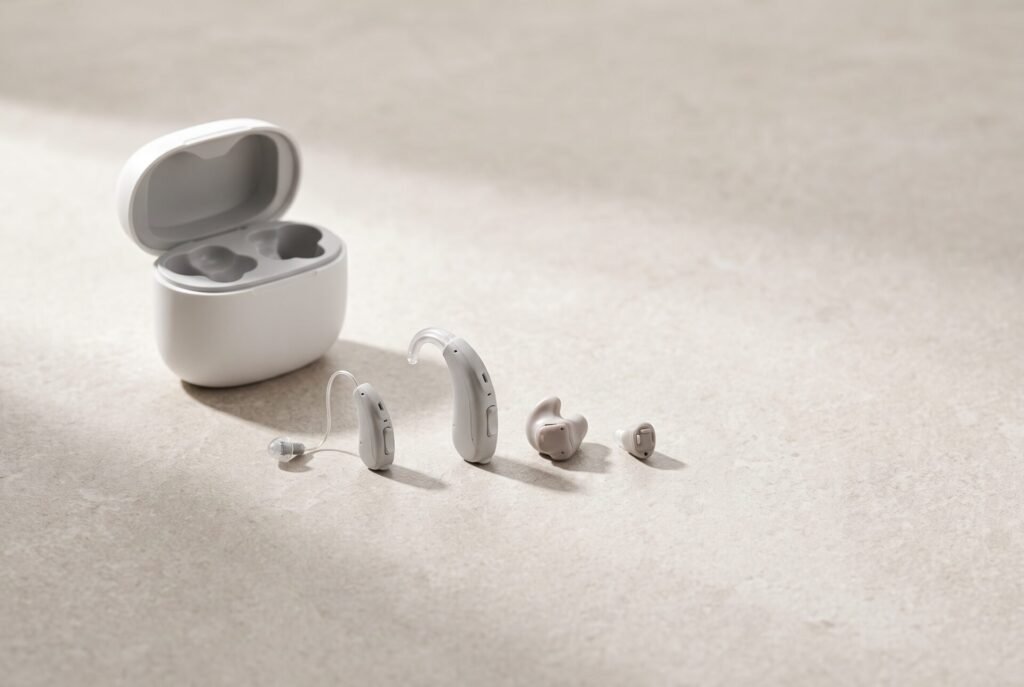
Starkey, whose hearing aids we fit at Harmony, describes five main styles:
- Receiver-in-canal (RIC): a small unit behind the ear with the speaker in the ear canal. Usually feature packed and a great option for mild to moderate hearing loss.
- Behind-the-ear (BTE): components sit behind the ear, with a tube carrying sound to an earbud or custom earmould. The world’s most common style, ideal for moderate to severe hearing loss.
- In-the-ear (ITE): custom made from a mould of your ear, for mild to severe hearing loss, and big enough for manual controls.
- Completely-in-canal (CIC): custom made to sit inside the ear canal, for mild to moderate hearing loss. The small size can make handling harder.
- Invisible-in-canal (IIC): the smallest, most discreet style. Starkey notes it cannot be worn by everyone and is only used for mild to moderate hearing loss.
Custom styles are made from an impression of your ear, which adds a manufacturing step. Smaller styles also involve trade-offs: Mayo Clinic notes that completely-in-canal aids use very small batteries with a shorter life and often lack extras such as volume control. Our hearing aid fitting page explains how we match the style to your hearing and ears.
3. Rechargeable or disposable batteries
Mayo Clinic says rechargeable batteries can make hearing aids easier to use because there is no battery to change, which helps anyone with stiff fingers or weaker eyesight. Battery life varies by model and style. Starkey states that its Edge AI rechargeable hearing aids offer up to 51 hours of battery life.
Disposable batteries carry an ongoing cost for replacements. The NHS advises considering the cost of batteries and whether you can change them easily.
4. Connectivity and smart features
Mayo Clinic notes that many hearing aids work with Bluetooth devices such as phones and televisions, and some can be controlled through a phone app.
Starkey’s premium models go further. Starkey describes its Edge AI hearing aids as using artificial intelligence to classify complex soundscapes, enhance speech and reduce noise in real time. With the My Starkey app, they can stream calls, help find lost hearing aids, and track exercise and cognitive activity. They also offer fall detection, which Starkey says can detect a fall and alert chosen family or friends. For families supporting a parent who lives alone, that can bring real peace of mind.
A good assessment helps you choose only the features you will actually use.
5. One ear or two
If you have hearing loss in both ears, the NIDCD says two hearing aids are generally recommended, because they give the brain a more natural signal and help you understand speech and locate where sounds come from. Two devices cost more than one, but for many people the difference in everyday hearing is significant.
6. The professional care included
A hearing aid is not simply a device you take home. The NHS explains that it is programmed to suit your level of hearing loss, and that adjusting can take a few weeks or months, with follow-up appointments to check progress. When comparing options, ask what is included:
- A full hearing test before you choose
- Fitting and programming to your results
- Follow-up appointments for fine-tuning
- Cleaning and maintenance
- Repairs, and what happens while your aid is being repaired
- The warranty, how long it lasts and what it covers
Why the cheapest option may not be the best value
The NIDCD is clear that price should not be the only factor, and that a more expensive hearing aid does not necessarily suit your needs better. The reverse is also true. A low price can hide extra costs for batteries, repairs or follow-up visits, or buy a device that does not match your hearing and ends up in a drawer.
Mayo Clinic says hearing aids should last about five years, and suggests asking whether a hearing aid’s power can be increased if your hearing changes. Thinking about value over that whole period, including aftercare, gives a truer picture than the upfront figure.
Amplifiers are not the same as fitted hearing aids
You may see inexpensive “sound amplifiers” online. The NIDCD explains that personal sound amplification products (PSAPs) are intended for people without hearing loss, to boost certain sounds in specific situations, and are not regulated as medical devices by the US Food and Drug Administration.
Over-the-counter hearing aids are a separate category in some countries. The NIDCD says they are meant for adults with perceived mild to moderate hearing loss, not for children or people with more severe loss. Prescription hearing aids are fitted and adjusted by a hearing professional for your specific hearing loss, and Mayo Clinic advises getting a hearing exam before getting any hearing aid.
An assessment can also uncover problems that need medical care rather than amplification, which is why Harmony works alongside ENT doctors. Where hearing aids are not enough, we are also an authorised MED-EL agent for hearing implants.
This article is for general information and is not medical advice.
Find the right fit for your hearing and budget
The best hearing aid suits your hearing, your daily life and your budget, and is looked after properly over the years. At Harmony, we choose, fit, fine-tune and care for Starkey hearing aids, including repairs and upgrades. Book an assessment so we can recommend options for your hearing and budget. You can also explore our hearing aids or read more about hearing.
Sources
- Mayo Clinic: Hearing aids: How to choose the right one
- NIDCD: Hearing Aids
- NIDCD: Over-the-Counter Hearing Aids
- NHS: Hearing aids and implants
- Starkey: Hearing aid styles
- Starkey: Edge AI hearing aids
- Starkey: My Starkey app
More articles

Tinnitus: common causes and what can help
Ringing, buzzing or humming in your ears? Learn what tinnitus is, what is often linked to it, when to see a doctor and what can help.
Read article
The cochlear implant journey: what to expect, step by step
Considering a cochlear implant for yourself or your child? A clear, step-by-step guide from the first assessment to everyday life with an implant.
Read article
7 signs your parent may need a hearing test
Is the TV getting louder at your parents' home? Here are seven common signs of hearing loss, why they matter, and how to raise the subject kindly.
Read article