

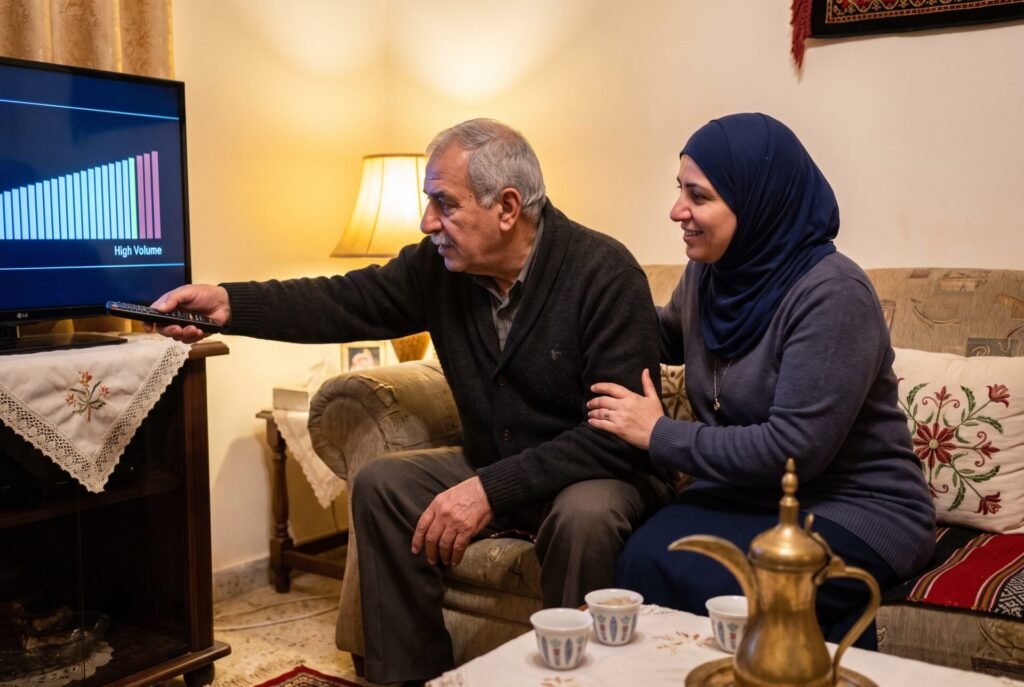
Hearing loss rarely arrives all at once. According to the US National Institute on Deafness and Other Communication Disorders (NIDCD), age-related hearing loss happens so gradually that people may not realise they have lost some of their hearing. The NHS makes a similar point: sometimes someone else notices the problem first.
That someone is often a son or daughter. If you have started to wonder about your mother or father, here are seven signs worth noticing, and how to take the next step together.
1. The TV volume keeps creeping up
The NHS lists watching TV at a volume higher than other people need as a common sign. If the news can be heard from the hallway, or others keep reaching for the remote to turn it down, take note.
2. “Can you say that again?”
Needing people to repeat themselves is another classic sign. Your parent may say “What?” more often, or nod along without quite catching what was said.
3. Pulling back from family gatherings
Friday lunch at the family home, a Ramadan iftar or a houseful of visitors during Eid are warm, lively occasions, but they are also noisy, with several conversations at once. The NHS notes that people with hearing loss often find it hard to keep up with conversation in noisy places.
A parent who was once at the centre of every gathering may start leaving early or sitting quietly at the edge. The NIDCD’s screening questions ask whether a hearing problem makes someone feel left out in a group, or visit relatives and neighbours less often than they would like. This kind of withdrawal is easy to put down to age or mood, when hearing may be part of the picture.
4. Mishearing and answering the wrong question
Misunderstanding what people say is high on the NHS list of symptoms. You ask about the weekend and get an answer about the weather. Funny once, but worth checking if it happens often.
5. Difficulty on the phone
On a call there are no lips to read and no expressions to help. The NHS lists difficulty hearing on the phone as a common sign. If calls with your parent have become shorter, more confused or are often handed to someone else, hearing could be the reason.
6. Ringing or buzzing in the ears
Tinnitus is the perception of sound that has no outside source. The NIDCD estimates that 10 to 25% of adults have it, and says most people with tinnitus have some degree of hearing loss. If your parent mentions a constant ringing or hum, a hearing check is a good idea. Read more on our tinnitus page.
7. Feeling worn out after conversations
Listening with hearing loss takes effort. The NHS describes feeling tired or stressed from having to concentrate while listening. If your parent seems drained after a family visit, the strain of following every word may be part of the reason.
Why it matters
The World Health Organization (WHO) reports that hearing loss becomes more common with age, and that among people older than 60, over 25% are affected by disabling hearing loss. The WHO lists the effects of unaddressed hearing loss as including limits on communication, social isolation, loneliness and stigma, and an increased risk of dementia and faster cognitive decline. The NIDCD adds that hearing loss can make it hard to respond to warnings or hear doorbells and smoke alarms.
The link with memory and thinking is still being researched, so it is worth describing carefully. In 2024, the Lancet Commission on dementia prevention, intervention and care estimated that nearly half of dementia cases worldwide could be prevented or delayed by addressing 14 risk factors. It linked hearing impairment, along with high LDL cholesterol, to the largest share of cases, at 7% each, and recommended making hearing aids available for everyone with hearing loss. This does not mean hearing loss causes dementia in any one person, or that a hearing aid guarantees protection. It does mean that looking after hearing is a sensible part of looking after overall health.
How to raise the subject gently
- Choose a quiet moment. Talk one to one, face to face, away from the TV and the crowd.
- Describe what you have noticed. “You seem tired after our lunches. Is it hard to follow everyone?” lands better than “You can’t hear anything.”
- Focus on what they enjoy. Hearing the grandchildren clearly and enjoying gatherings again are positive reasons to get checked.
- Offer to go with them. Booking together and going along can make a big difference.
- Adjust how you speak. The NIDCD suggests facing the person, speaking louder but not shouting, and turning down background noise.
What happens at a hearing test
A hearing test is painless. The American Speech-Language-Hearing Association (ASHA) describes the most common tests:
- Pure-tone testing: wearing earphones and responding to tones, usually from low pitches (250 Hz) to high pitches (8000 Hz), which cover the sounds needed to understand speech. Results are plotted on a chart called an audiogram.
- Speech testing: repeating words heard at different volumes.
- Middle ear checks: such as tympanometry, where a small probe checks how well the eardrum moves.
Afterwards, the results are explained and options discussed. Not every hearing problem needs a hearing aid. Some causes, such as earwax or infection, can be treated, which is why Harmony works alongside ENT doctors. Learn more about our hearing tests, types of hearing loss and hearing aids.
The NHS advises getting urgent medical help for sudden hearing loss, or hearing that has worsened over a few days or weeks. Do not wait for a routine appointment in those cases.
This article is for general information and is not medical advice.
Take the first step together
If these signs sound familiar, a hearing test is a simple, reassuring place to start. Harmony in Amman tests hearing for adults and children and explains every result in plain language. Book a hearing test for your parent, and go along with them if you can.
Sources
- World Health Organization: Deafness and hearing loss fact sheet
- NIDCD: Age-Related Hearing Loss (Presbycusis)
- NIDCD: Tinnitus
- NHS: Hearing loss
- UCL News: Nearly half of dementia cases could be prevented or delayed by tackling 14 risk factors (2024 Lancet Commission)
- The Lancet: Dementia prevention, intervention, and care: 2024 report of the Lancet standing Commission
- ASHA: Types of Hearing Tests
More articles

Tinnitus: common causes and what can help
Ringing, buzzing or humming in your ears? Learn what tinnitus is, what is often linked to it, when to see a doctor and what can help.
Read article
The cochlear implant journey: what to expect, step by step
Considering a cochlear implant for yourself or your child? A clear, step-by-step guide from the first assessment to everyday life with an implant.
Read article
What affects the cost of a hearing aid?
Why do hearing aids vary so much in cost? We explain technology levels, styles, batteries, features and the professional care that comes with a fitting.
Read article